
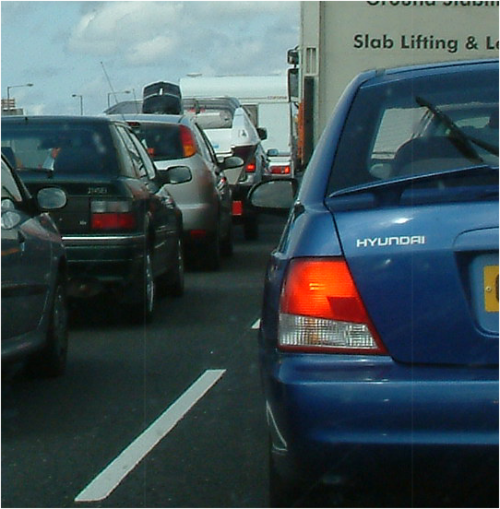
 Braking is simply a matter of putting your right foot on the brake pedal and pressing.
Good braking, on the other hand, requires a lot of skill and practise.
Your car should remain balanced as you slow down without excessive pitching (dipping at the front and rear). You can achieve this by braking early and using progressive, variable pressure on the brake pedal.
In order to start raising your awareness of the way you use the brake pedal it might help to think of the words 'ease and squeeze' when braking normally.
In fact, think of the words 'eeeeeeeeeeze and squeeeeeeeeeze' (as taught to me by an elderly retired police officer many years ago!) for really fine control of both accelerator and brakes.
Ideally, as the car comes to halt the pressure on the brake should be almost zero (in many situations, your foot will be off the brake completely).
The amount of pressure that is initially applied to the brake pedal will depend on how fast you are travelling and how soon you want to stop. As a general rule, the faster you are going, the harder you will press the brake pedal.
1. Take up the slack
Here you simply press the brake pedal enough to 'feel' the brakes starting to bite. This also switches on the brake lights to warn following drivers.
2. More pressure
Here you apply more pressure to lose the bulk of your speed. The degree of pressure and how long you hold it will depend on your speed.
3. Ease off
Here you ease the pressure on the brake pedal, sometimes releasing it altogether. This will allow the car to 'roll' to a smooth stop.
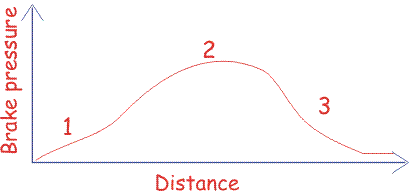
If you find it difficult to brake progressively in everyday driving, leave a bigger gap between your car and the vehicles that you are following. Also, find a long quiet road where you can practice braking with differing degrees of pedal pressure.
Of course, things won't always go to plan, see the next page for what to do if things go wrong...

So just occasionally, you're going too fast and find that you need to lose speed quickly, what do you do?
Whatever the situation, you need to get as much grip as possible as quickly as possible. This means that you can forget the finesse mentioned on the previous page.
Hit the brakes hard and fast.
Optimum grip is gained just before the wheels lock, this is why many advanced driver trainers suggest 'cadence' or 'pulse' braking (pumping the brakes) for stopping quickly and maintaining steering control. On race tracks drivers use 'threshold braking' (braking just to the limit point without locking the wheels).
In an emergency, most human beings, and certainly most average drivers, simply don't have the mechanical ability (bodily) to use cadence or pulse braking quick enough to be of practical use. Threshold braking is ideal but generally needs lots of sensitivity and practise to be done efficiently, again, a skill that the majority of road drivers don't posses.
The best thing to do is 'slam' on the brakes and hold them - or at least to apply fast, progressive, hard and controlled pressure. In all modern cars this will activate the anti-lock braking system which will 'pulse' the brakes for you. If you have never experience anti-lock brakes in action, take your car to a quiet road and test them out, that way the pulsing sound won't take you by surprise in an emergency situation.
In cars without anti-lock brakes pressing the brake pedal hard will probably cause you to skid. Even though you won't have absolute maximum grip (as with threshold braking), you will be making maximum use of the available grip (not wasting it by releasing the brakes). There are issues with grip as the tyre rubber melts and lubricates the road surface but this is probably still the quickest way to stop in a straight line on a good dry road surface (see emergency braking).
(Without ABS: If you are heading towards an obstacle, or too fast into a bend, look for the way out, slide the car in a straight line for as long as possible (while turning the steering wheel) and release the brakes at the last moment. Keep a firm grip of the wheel and be ready to take corrective steering action because the rear end of the car might object to this treatment and try to overtake the front!)
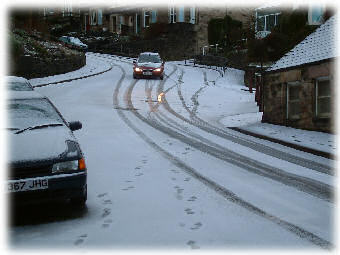 Very slippery?
On ice and snow, keep your speed under control. In this instance sensitive, balanced braking will give maximum grip. Because of the extended stopping distance, you will not gain efficiency by sliding.
Anti lock braking systems and traction control systems will often improve stopping efficiency in poor conditions*, but they do not offer a substitute for safe driving.
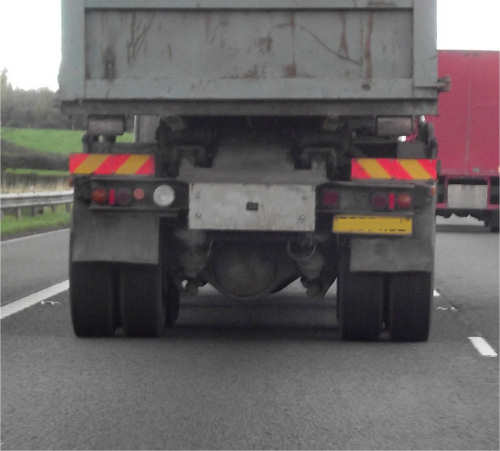 ABS operates by rapidly pumping the brakes on and off several times per second (much faster than the best and quickest human). This allows the driver to maintain directional control in an emergency. This is especially useful if you get into trouble on a slippery surface.
ABS is a standard requirement on modern cars but when it was first introduced cars equipped with ABS attracted a lower insurance premium - however, insurance companies soon discovered that ABS did not lead to fewer claims, just different claims. ABS is a valuable safety addition to cars but will not compensate for bad driving!
For drivers who 'tailgate' ABS will be of little use. If your view from the drivers seat is usually like the picture on the right - drop back!
Your driving instructor probably told you about the two-second rule - if you keep a safe distance you can avoid the need for emergency braking.
The latest technologies go one step beyond ABS and intervene when a vehicle seems to be going off course. This is done by applying the brakes on individual wheels.
Points to bear in mind when using ABS
Read your vehicle manual:
Your owner's manual will explain how to use the ABS most efficiently in your particular vehicle.
Keep your foot on the brake:
With many systems that can be a noise (like a machine gun) and a pulsating of the brake pedal. The first time you experience this it can feel strange. Don't wait for an emergency, go out and test your ABS to get a feel for it (Note: Ensure that you do this in a safe location that is clear of other traffic and people).
Remember to steer:
This means looking where you want to go (your escape route). This might mean looking at the verge and driving off the road. If you stare at the danger, your arms won't work and you will still hit it.
The rule is 'Look at what you want to hit!' - the space, not the obstruction.
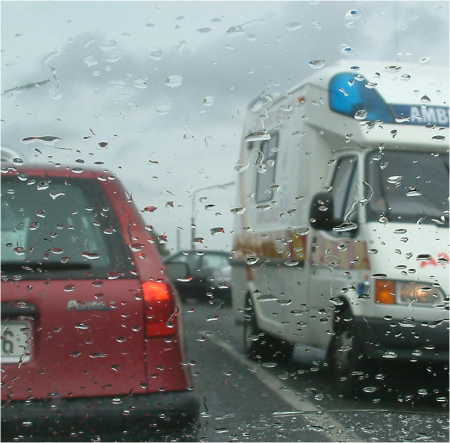 If you drive within your own and the car's capabilities, and if you are constantly reading the road ahead you should never need to use emergency braking.
However, from time to time we all get sloppy (driving instructors included) and are just a little bit naughty on the road - or get caught out because we are tired or unwell (and perhaps shouldn't be driving).
The first rule of emergency braking is that if there is not enough room to stop, braking harder won't make the gap bigger!
In an emergency you have a choice – hit it or avoid it. So, while driving, you should constantly be looking for 'a way out'...
Where will you go if...
- The load falls off the truck?
- The car approaching has a blow-out?
- The kid fall off his bike?
- A dog runs out?
- The driver ahead falls asleep?
Or any one of a thousand other everyday occurrences that take people by surprise?
If you are always expecting things to happen and looking for a way out, when faced with an emergency you will instinctively steer for safety because your brain will recognise that there is a choice (the principle here is that you hit what you are looking at... In this case, the space). Note that In some situation the way out could be to drive off the road.
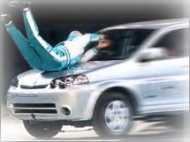
If there is a stationary car or van ahead and there is neither enough room to stop nor a way out, aim to hit it square in the rear. Make maximum use of the 'crumple zones' of each 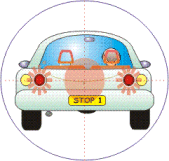 vehicle. If its a truck, flatten yourself across the seats and pray!
If you need to brake and steer in an older car without ABS, release and reapply the brakes in quick succession; the wheels will only steer when they are rotating. In a modern car with ABS (all cars in Europe since 2007) keep your foot hard down on the brake pedal until you are safe, press the clutch at the same time as you brake to allow the system to work at maximum efficiency.
Note: Anti-lock brakes can be a danger if there is not enough room to steer clear of the obstruction ahead. Remember, if you are going to hit something the more crumple zone you can put between you and it the better.
Hitting other vehicles or obstructions at a 45 degree glancing blow will not be as safe as a full blown direct impact. I hope you never have to make this decision!
 Don't wait for a real emergency to find out how your anti-lock brakes work. Practise activating your anti-lock system when you get a safe opportunity to find out what it feels like (And by the way, you can relax if the brakes sound like a machine gun - they're supposed to make that noise!)
Remember, if you can stop in a straight line on a good dry surface the quickest way with or without ABS will be threshold braking - but this takes a lot of skill, especially with adrenalin pumping.
For most drivers, with ABS just press the brake pedal and keep it pressed.
In cars without ABS the quickest way to stop on a good dry surface will probably be to press the brake and clutch, lock all of your wheels and slide (don't believe everything that your driving instructor told you!). If you need to avoid an obstacle use the same technique but release the brakes to steer and then quickly reapply - increase and relax brake pedal pressure repeatedly and in quick succession.
The best way to deal with emergency braking is to avoid emergencies. The next best way is to practise emergencies! You can do this on a skid-training or limit-handling course with an experienced trainer in a safe track or other off road environment.
Whether you are a professional driver, a weekend driver or someone who is thinking of taking a driving instructor training course the information on this page can make you, and those around you, much safer on the roads.
For info about limit-handling and ice driving courses visit Don Palmer's web site.