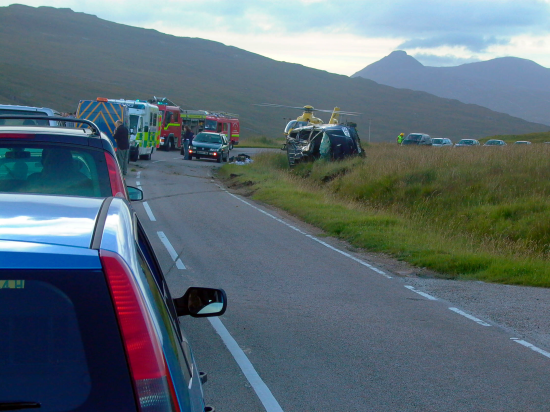
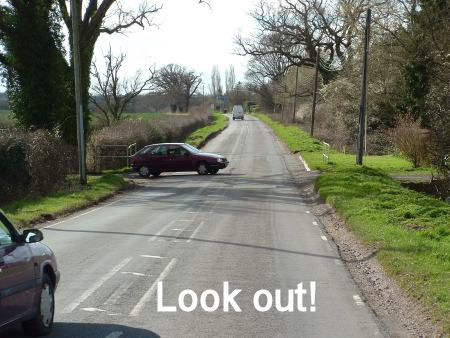
 Accidents like the one shown here could be easily avoided with a little planning and forethought - driving can be fun on open roads, and so can overtaking... But only within the rules and with care.
It's quite possible that your driving instructor didn't teach you how to overtake safely, in which case this page will raise your awareness of overtaking risks and how they can be minimised.
A well planned and well executed overtaking manoeuvre is no more dangerous than any other manoeuvre. The important thing to remember is that you should avoid impulsive, opportunist overtakes.
The time to decide whether or not you want to overtake is when you first come up behind a vehicle, not when you see a gap. You may decide to overtake a vehicle and then follow it for miles before an opportunity arises. The opportunity might not arise. Don't force it!
If you are a driving instructor, you might find the ideas form a useful starting point for your overtaking lessons (lots more instruction advice/tips in the members area).
Researchers at Nottingham University determined the following statistics when studying police records of overtaking accidents:
The statistics certainly show that there is a lot of room for improvement, but what improvements can be made, and how?
 In an ideal world, overtaking accidents would be prevented by better road design; however, one of the problems is that many of our roads were first built sixty or more years ago.
Safety on these roads can be improved by road markings designed to deter overtaking.
Markings include solid white lines along the edge of the carriageway (these encourage drivers to keep to the centre of their lane rather than positioning to the left); hatching along the centre of two-way roads, solid centre lines, etc., but there is only so much that can be done to change existing roads.
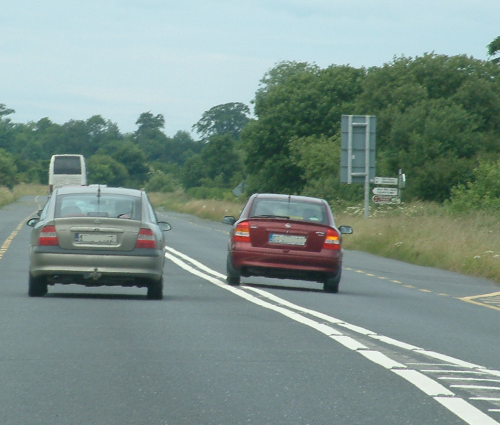
Ultimately, a change in driver behaviour is essential for continuing improvements in overtaking safety. No amount of paint will stop drivers like the one in the photo.
A good starting point for overtaking safety might be to always make your decisions based on the following two questions:
A lot of the frustration that is experienced by drivers is brought about by their seeming inability to consider their journey as whole as opposed to simply concentrating on the next 100 metres of road space. In order to answer the question "Do I need to overtake?" you must take account of the whole journey and expected arrival time. Unless the journey is part of a life and death emergency, there is probably no real 'need' to overtake at all. Overtaking a few cars is unlikely to get you there any quicker!
The driver in the picture are taking a major risk by overtaking across solid lines, not only is this illegal, it's highly dangerous - notice that the oncoming truck is flashing his headlights in warning (anger?). Also, if you look deep into the picture you can see a queue of traffic ahead - so the overtake is unlikely to gain these drivers any time.
If you have a sat-nav that shows your estimated time of arrival you will probably realise that regardless of how you drive,when you are in a steady moving traffic situation your arrival time will vary very little - several overtakes might but you a few minutes but more often than not overtaking won't make any difference. So when answering the question 'Do I need to overtake?' ask yourself how much time you will gain and what you will do with that time.
Overtaking can be useful if you are stuck behind a single or couple of slow moving vehicles on an open road, or to maintain a good cruising speed on motorways but in most other situations it will be a waste of time, fuel and effort - and will often be stressful. Having said this I occasionally go out for a drive, just for the sake of driving - on these occasions I'll overtake just for the sake of overtaking; BUT... I'm no in a hurry and I take the utmost care to plan the overtakes... Also, the cars I overtake often catch me at the next traffic lights!
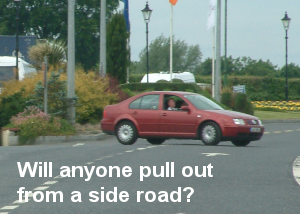 When following a long queue of traffic, or approaching a built up area, overtaking one or two vehicles is unlikely to affect your overall journey time, but will definitely increase your risk of an accident. But if you really feel that overtaking is worthwhile, consider waiting for the right opportunity.
There is a simple rule which says ... 'Good driving starts in bed'...
This rule makes absolute sense when reducing the need to overtake – get up earlier and allow more time for your journey. This fits neatly with my own 'Ten minute rule' – allow an extra ten minutes journey time for every hour you expect to travel. However, even if you leave plenty of time there may still be occasions when you want to overtake; when these situations arise you must be well equipped with an overtaking plan.
 Before starting any overtaking manoeuvre, consider the safety and legality of the location.
You are looking for anything that might make your manoeuvre unsafe. The obvious things are road features, markings and signs. Bends, hill crests, solid white lines, hatched areas, 'No Overtaking' signs, pedestrian crossings, etc. Defensive drivers will also be considering other information. A 'cattle' warning sign, for example, might draw your attention to a greasy road surface which could cause danger when overtaking; skid marks might indicate a concealed entrance.
You should also aim to find a location that will minimise time spent on the wrong side of the road. With this in mind you could consider overtaking immediately after a junction or bend where the target vehicle's speed is slowest. If you do this, care must be taken not to surprise or upset the driver you are overtaking (see 'the two P's below).
To reduce the risk of giving approaching drivers a heart-attack (fear!), you must be able to judge the speed of the 'closing-gap' accurately. If two vehicles approaching each other at 45mph and 55mph respectively, the gap between them will be closing at approximately 48 metres per second. (Pace out 48 metres to see how long it is ... Then try it with your eyes closed to get a sense of  the danger!)
In addition to approaching vehicles, you must also consider the vehicle that you are intending to pass.
Beware of cars with 'lucky-dice' dangling from the mirror – they are often driven by gamblers!
I remember an invaluable driving rule that I picked up from a police instructor many years ago – it's ideal when making the decision to overtake and simply states that you must always remember the two P's:
First: Is your manoeuvre Practical? Consider whether your manoeuvre is practical (bearing in mind the points outlined in this article).
Second: Is your manoeuvre Political? What will other road users think? Even though your expert knowledge tells you that it's perfectly safe to overtake, that safety can soon be put in jeopardy by another road user who takes exception to your actions.
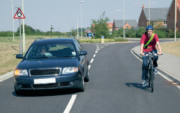 Space: Another important consideration is ensuring that you leave enough space for the vehicle you are passing. If you get too close you can distract other drivers. Cutting in after overtaking can cause people to panic brake or swerve.
Also make sure that you allow enough clearance when passing vulnerable road users such a cyclists or horse riders - cyclist night wobble, hit uneven road surface or be blown off course by the wind, because of this you should leave at least as much space as you would when passing a car, preferably more.
In order to overtake safely you need to be quick and stable. Quick to minimise your 'time exposed to danger' on the wrong side of the road. Stable to maintain control, especially if things don't go to plan
Your ability to be quick will depend to a degree on the vehicle that you are driving. If your car is not powerful enough to overtake using the method outlined below, it's not safe to overtake. Avoid the temptation to 'wind up and swoop out'. While this method will work, you are dependant upon the actions of others to maintain your safety margins. If something unforeseen happens you will be left with no escape route.
Keep your vehicle stable by choosing the safe overtaking path shown on the diagram below. (The red line shows the unstable path taken by 'swoop out' drivers).
 The numbers (in brackets) correspond to the numbers shown on the diagram.
Mirrors
Early repeated mirror checks are required to ensure that the road behind is safe and that you are not being overtaken yourself.
Hang-back
If the road appears to be clear ahead of the 'target' vehicle, close the gap to your 'launch point' selecting the most appropriate gear for brisk acceleration. Ensure that you position to maintain maximum forward vision. Never hold a position that is closer than a one second gap on a good, dry road.
Mirrors/Signals
Make a final check of all mirrors and consider a direction signal to show that you are moving out and/or a flashing headlamp signal to alert the driver ahead to your presence. Also check that the target vehicle, or other vehicles ahead, are not signalling to turn.
Position
Position: Move out with moderate acceleration (1). If the road is still clear increase power to drive through (2). Note that you MUST NEVER commit to the manoeuvre until you have reached this point (1) and seen that the road ahead is clear. Always be prepared to drop back.
Mirrors/Position
(2) Ensuring that the 'target' car is clearly visible in the nearside mirror, start your gradual straight-line return to the left.
Mirrors
At (3) the overtaken vehicle should be clearly visible in your centre mirror and you should be pulling away to (4) opening the gap.
The red line shows how not to overtake!
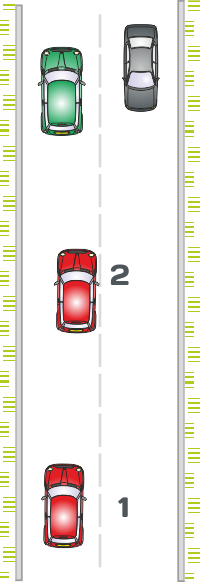 Hang-back is the name given to the road position that you should adopt prior to making your final commitment to overtake. This position will provide a good 'zone of vision' which will in turn assist your planning for the overtake.
We recommend that the hang-back position should only be used by experienced drivers who have had specific training in overtaking, for example on an advanced driving course.
The hang-back position (2) is substantially closer to the vehicle in front than what is considered to be a normal safe following position (1) - it will normally approximate to your 'thinking distance'.
This position eliminates the need to close up a lot of space immediately prior to overtaking and enables the manoeuvre to be completed quicker and over a shorter distance. You must, however, compensate for the lack of separation distance by being 'hyper aware' of risks/dangers ahead.
While 'hanging back', you may need to adjust your road position to the right or left in order to maximise forward vision, for example, if the road curves to the left ahead you may get a better view by moving to the left and looking beyond the 'target' to the nearside. If there are junctions or other openings ahead drop back until or unless you are absolutely sure that vehicles will not emerge.
The hang-back position should not be adopted indefinitely, it is a temporary position that can be adopted when a likely overtake is imminent. Driving in this position can place increased stress levels on the drivers of both the overtaking vehicle and the target vehicle.
If an expected overtaking opportunity does not materialise or seem to be likely in the short term, a normal two-second following distance must be re-established for safety.
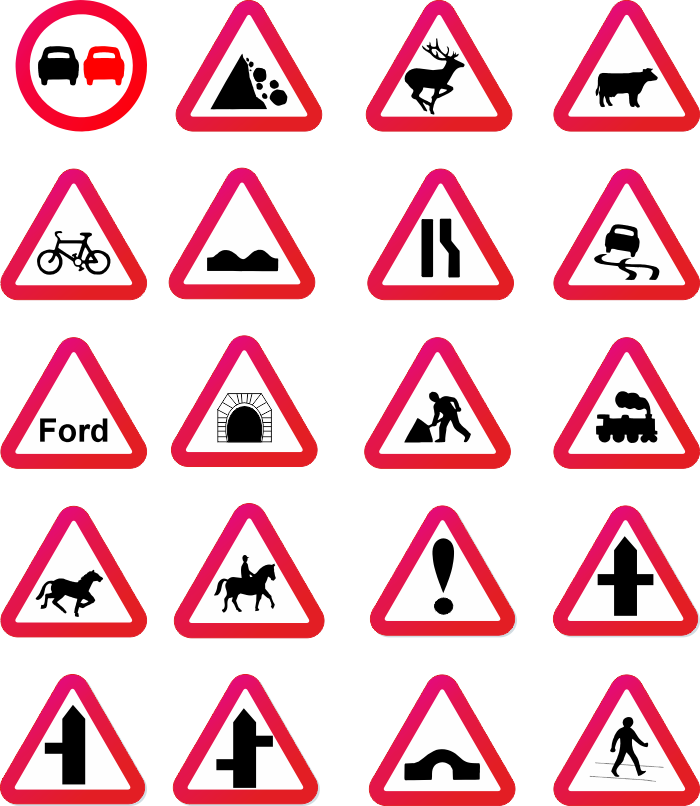
OK only the first one is a legal requirement. If you overtake where you see this sign you can be prosecuted for not obeying the sign.
However, all the other signs suggest that overtaking might be dangerous - in the event of an accident the presence of a road sign could be used by the prosecution where a charge of dangerous or careless driving was being brought.
Do you know all the signs? If not download a free book from the Directgov web site by clicking here.
We don't live in an ideal world, effective journey planning will help to ease frustration and reduce your need to overtake, choose a safe overtaking location, remember the two P's, and make sure that you are 'quick and stable'.