
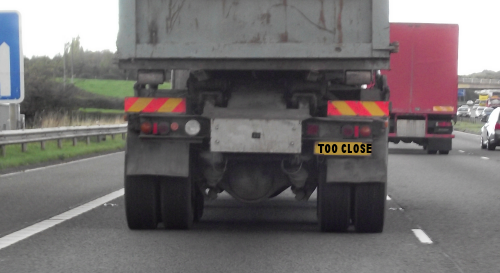
 This section contains similar advice to that is often given to learner drivers - but don't be misled into thinking that this is 'kids stuff'...
As far as space is concerned, the only difference between learners and advanced drivers is experience.
Given that people are killed and injured as a result of running out of space, the information on these pages will go a long way towards keeping you, and your loved ones, safe on the road.
Astronauts don't need the skill of controlling the space around their rockets – there is virtually no chance of them bumping into another spaceship, nor of them being hit from behind!
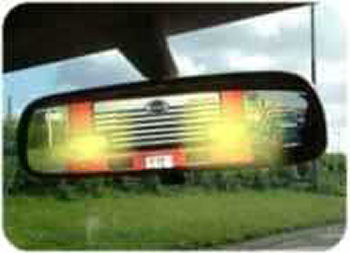
Back down here on Earth drivers still have to 'driving in space' but for them the space is man made - that is, driver-made. If you are familiar with a view similar to that shown in the picture above when driving - you're not making enough space for yourself, or for those following behind.
Drivers need to keep a safe space between their vehicles and other road users, bollards, trees and walls, etcetera – the safety bubble.
This section will explains the basics of maintaining a safety bubble around your vehicle.
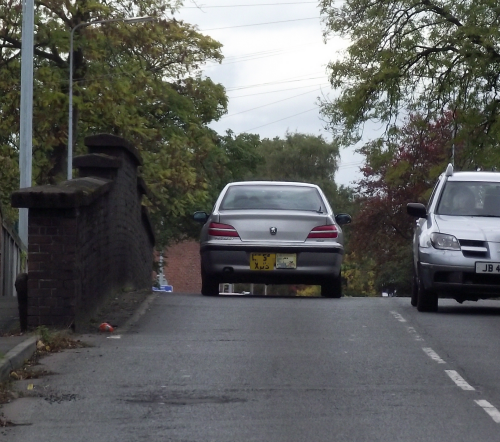 The safety space in front is the easiest one for you to control. You can adjust the gap between yourself and the vehicle in front by simply varying your speed. If you regularly get a close up view of large vehicles (or slow vehicles for that matter!) you need to develop the skill of maintaining a safe gap.
The picture on the right was taken from a car travelling at about 15 mph. The driver has kept back for three reasons.
Your forward safety gap must always be large enough for you to stop safely if necessary; an easy way to maintain this gap on a dry road is to use the 'two-second rule'.
On a clear road you should always be able to stop safely.
You will often here trainers say that you should be able to stop 'well within the distance that you can see to be clear ahead' - but this is not enough, especially if you are driving fast. You need to be able to stop in in half of the clear distance that you can see ahead - this gives a good margin for error if, for example, another car comes around a bend on your side of the road at the same speed as you.
Applying this rule is easy. First, watch the vehicle ahead pass a static marker point. A tree, a phone box, a lamp-post, a motorway bridge or any other fixed reference point.
 As the vehicle passes the fixed point, recite the following phrase at a normal speaking rate:
'Only a fool breaks the two-second rule'
This should take approximately two seconds to say.
You should have finished the phrase as, or before, you reach the fixed reference point.
If you pass the point before you finish speaking, you are too close to the vehicle in front; pull back and try again.
In poor weather conditions your gap should be at least double.
As the vehicle passes the fixed point, recite the following phrase at a normal speaking rate:
'Only a fool breaks the two-second rule - and more time in the wet' This should take approximately four seconds to say.
Again, you should have finished the phrase as, or before, you reach the fixed reference point.
Initially the gap might seem to you to be very large – if this is the case, it's indicative of the fact that up to now, you have been driving dangerously close and trusting 'good luck' to keep you alive.
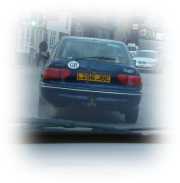 The two-second-rule will help you to maintain a safe distance when your car is moving, but you must also consider the gap to the front when you stop in traffic queues.
If you always leave enough room to steer around the vehicle in front the gap should be big enough for any eventuality (about 2 metres).
An easy way to measure this for yourself is to use the 'tyres and tarmac' rule. When stopped behind another vehicle you should be able to see its rear tyres and some of the road surface behind them.
 If the vehicle behind is following too closely, you need to increase your forward safety gap. Doing this will protect you and the driver behind in an emergency because there will be enough room for you both to stop safely.
Another easy way to control this gap is to allow the vehicle behind you to overtake; this will make no difference to your journey time but it will reduce the risk of a rear end shunt and a broken neck. You are not in a race!
I often come across drivers who seem to consider that when they are overtaken, the other drivers are 'stealing their space'. This is insanity!
At any time there are millions of vehicles joining roads behind you and ahead of you.
If you are travelling at 50 mph and someone overtakes, you are still travelling at 50 mph and have not lost anything.
If you are male and consider being overtaken an 'affront to your manhood' – see a doctor and get a life! (Another term might be 'grow up'!)
If you regularly find that you are stressed by vehicles following too close behind, start to allow a little longer for your journeys. And use the extra time to slow down and let people pass. It might well be that the driver behind is an idiot. All the more reason to have him in front where you can see him!'
A sure way to get a tailgater to follow even more closely is to 'bang on the brakes to teach him a lesson'.
You won't teach him anything. Except that he is having a bad day and that he has an idiot in front. By all means show your brake lights early when you see a problem ahead, but don't get mad!
For lots of information about dealing with tailgaters see the SmartDriving section on 'Tailgating'.
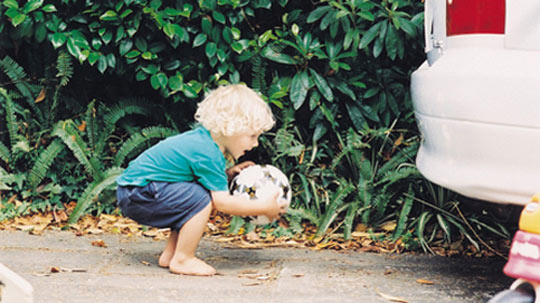 When reversing, you have direct control over your rear safety gap.
The important point to remember here is to drive slowly, so that you can always stop safely if required.
Perhaps more important than speed when reversing is knowing that there is a gap. Its easy to see the road or car-park 3 or 4 metres back, but what's immediately behind you.
The blind spot immediately behind can be a particular problem with larger SUV's (4x4's) and 'people carriers' but it is still an issue with smaller cars. Sadly, almost every year we hear a tragic story of someone, often a parent, running over a child because they did not know that the child was behind the car.
If you regularly reverse in situations where there are kids around, fit a special 'rear blind spot' lens, mirror or camera.
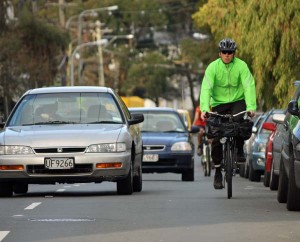 You need space to the sides to avoid pedestrians, cyclists, oncoming vehicles, horses and many other hazards.
You can control this space by holding back from narrow gaps until you are 100 per cent certain that there is enough room for error.
Allow at least two metres' (two yards') clearance when passing cyclists – a court case some years ago laid down the principle that a cyclist is entitled to wobble!
Another way to gauge an absolute minimum safe distance past cyclists is to imagine the bike, and and adult rider, lying flat on the road – how much space would they take up?
One of the biggest problems with space to the sides is found in side streets packed with parked vehicles.
Sometimes you have no choice but than to squeeze through a narrow gap. In these situations slow down to compensate – this might mean walking pace.
A court ruling in the UK determined that a cyclist has a 'right to wobble' - leave enough wobble space!
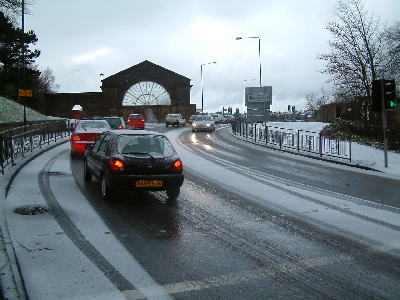
You will sometimes need to have extra space around you.
Think about how the following factors may affect the safety gap that you need to leave.
Driving when you are tired
Driving when you are unwell
Driving a strange car