
 Regular servicing will ensure your brakes are in good working order. Sudden brake failure in well maintained cars is possible but you are probably more likely to be hit by lightning.
Get into the habit of checking your brakes every time you get behind the wheel. Brake testing only takes a few seconds to do and will become habit after a while. There are two checks that you can make - Static and Rolling.
Static brake test:
The static brake test is just a matter of pressing the brake pedal when you get into the car. There should be resistance from the pedal; if there isn't and the pedal feels soft or easily pushes to the floor you have probably got a fluid leak and should not drive the car.Rolling brake test:
Complete your 'rolling brake test' by pressing the brake pedal gently as soon as possible after moving off and while driving slowly. This will reassure you that your brakes are OK before you need them. Note: this is not an emergency stop! Simply 'feel' the brakes at five or ten miles per hour.
Brakes operate on a hydraulic system; for the system to work effectively there must be fluid in the hydraulic pipes. If the fluid starts to leak from the system the brake pedal will feel 'softer' and will often travel further when pressed. If your brake pedal feels soft or 'spongy' stop immediately and get a breakdown mechanic to check the car.
When the brake pedal feels soft, you might be able to build up brake pressure by repeatedly pumping it, however, this is only an 'emergency' measure to stop the car once - it is not a 'get you home' solution. Driving with a 'soft' brake pedal is extremely dangerous because your brakes could fail at any moment, even if they don't fail they will be inefficient, possibly leading to an accident.
If your brake pedal feels hard and the brakes are not working or are inefficient, something might have broken in the braking system - BUT... It could just be that something is jammed under the brake pedal. This is why you should keep the floor area of your vehicle free of litter and other stuff that could slide under the pedals.
 As explained above, total brake failure is rare, however, you will see from news stories that it occasionally happens - in 2010 Chrysler, Honda, Volvo and Toyota recalled vehicles at risk of brake failure.
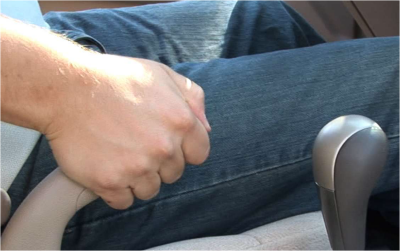
If you need to stop 'now!' use a hand operated parking brake (handbrake) in an on-off pumping motion, keep the release button pressed as you do this.
If there's time, change to second gear and bring the clutch up gently (the engine compression will make the clutch feel like a brake) then use the parking brake to stop. In an automatic, shift to 'low' - if there is a manual option on your auto, change down one gear at a time.
If you have a pedal operated parking brake you need to operate the brake release handle at the same time to avoid locking the rear wheels - parking brakes only operate on the rear wheels (with very rare exceptions).
Warning Using the parking brake or dropping a gear at high speed could be dangerous and lead to a loss of control - lose as much speed as you can naturally before doing either of these things.
If you use the parking brake pull it gradually - a sudden tug on the brake or push on the parking brake pedal could lock the wheels and lead to loss of control. Locking the wheels might slow the car quickly in a straight line but the resultant skid could make the vehicle uncontrollable, possibly skidding off the road. If you have an electronic parking brake only use it in a last resort emergency - these brakes tend to operate on an 'on/off' basis and will probably lock your wheels solid.
Another method is to change to a low gear and switch off your engine. However, extreme caution is required if this is done. You must have a straight run off space in which to stop; this is because your power steering will fail as soon as the engine is switched off - it could be almost impossible to turn the wheel.
A second danger of switching off the engine is that the steering lock could engage; in some models this can happen even if the key is still in the ignition switch. Find out how your steering lock operates now - if you wait until your brakes fail it will be too late.
It is reassuring to note that most cars built since the early 1990's have 'dual circuit' brakes which will still work on at least two wheels in the event of a hydraulic system failure. Dual-circuit brake systems are a safety feature that effectively incorporates two separate hydraulic systems, if one fails the other still operates.
 In absolute extreme situations you may need to 'crash' your car in order to stop - however, this is an extreme last resort action.
If you make the choice to crash, avoid sudden deceleration which will lead to total loss of control. It is essential to control then crash as much as possible. The idea is to 'drag' the car to a halt.
You MUST NEVER crash head on into objects or vehicles.
When the car has slowed down using other methods (above), you can 'crash' by running parallel along a kerb, a crash barrier or a wall. Doing this will cause extensive damage to your vehicle. Also you must be aware that a kerb must only be used if you have full control and can keep the car straight - hitting a kerb hard, or at speed, can flip a vehicle over. If there is an opportunity to run off into gravel or a muddy verge that will also slow the car but only do this if you can steer a straight line - wheels can 'dig in' if you turn on soft ground causing the car to flip over.
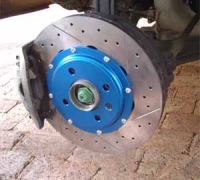 Brake fade refers to a situation where the brakes lose efficiency (or possibly fail completely). It is extremely rare in modern, well maintained vehicles.
There are two causes of brake fade. The most common, and the one which was experienced by our motorists in the first part of the 20th century, is caused by overheated brake pads (the bits that press onto the wheel to slow it down). This is almost unheard of with modern brake technology - you would need to brake long and hard down a (very, very) long hill. When the brakes cool down they work OK again.
The second type is caused by water in the brake fluid. When the fluid gets hot the water can vaporise. Steam (unlike brake fluid) will compress - therefore instead of your braking effort being transmitted to the wheels, it is dissipated as the steam compresses. When the system cools down the brakes will seem OK again. If your car is regularly serviced, the brake fluid will be replaced periodically and this problem will never arise.
If your parking brake (handbrake) fails, leave the car in first or reverse gear (or Park) when you park and chock your front wheels against the kerb. It is not wise to leave your car on a hill if your parking brake fails, even with the wheels chocked.
Stay calm - stay safe!