
 I recall a seeing a story in the news about an elderly gentleman who was stopped after knocking over the cones at a police roadside checkpoint. His distance vision was something in the region of twenty feet - around 30% of the requirements!
It's estimated that eyesight can start to deteriorate as early as twenty years of age and that for every thirteen after twenty we need twice as much light to see as well as we do when younger.
To ensure that your eyesight is OK, complete the eyesight checks on this page.
If you have even the slightest doubt about whether your eyesight is OK for driving you should not drive again until you have seen an optician or other eyesight specialist.
Drivers can now have their licences revoked immediately if they fail a roadside eye test.
For the test the police will ask the driver to read a number plate from 20 metres (66ft), around five car lengths. This is the same that learners face at the start of their practical driving test.
If the driver fails the eye test, they could be instantly banned from the road.
Officers can request an urgent revocation of a licence through the DVLA if they believe the safety of other road users will be put at risk if a driver remains on the road.
The power was introduced in 2013 under Cassie's Law, named after 16-year-old Cassie McCord who died when a man aged 87 lost control of his vehicle in Colchester, Essex.
The law states that all drivers of motor cars must be able to read a standard number plate, in good daylight, from a distance of twenty metres – with spectacles or corrective lenses if required.
The first of the checks (below) will ensure that you meet the legal minimum requirement for drivers.
The second check is simply to find out (for your own interest) how 'good' your distant vision is. If you are planning to drive Formula 1 racing cars in your spare time nothing less than 20-20 vision is good enough!
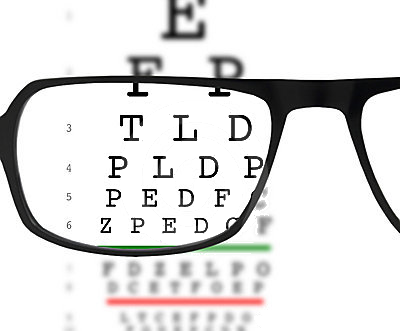 Eyesight check No 1
Pace out the correct distance from a (standard) car number plate, to meet the legal minimum eyesight requirement (20 metres) and make sure that you can read the number easily without squinting or screwing up your eyes (a good stride is approximately 1 metre).
Find a number plate that is so far away that you cannot read it. Walk towards it until you can just read it.
Pace out the distance from the point at which you can just read it to the vehicle - is this well over 20 metres? If not, it's worth getting an eye check, especially if you have always had good vision or have not had an eye-check for a long time..
As a guide to your eyesight try the free number plate test at:
You will find the basic number plate test listed under 'Free Extras' on the page menu.
Make sure that you read the instructions carefully and follow the test exactly as directed.
On the same site there is a more comprehensive test designed for commercial drivers - SeeDrivePro. This test requires a small fee of £3 for the results.
We particularly recommend the SeeDrivePro test for drivers who have never worn glasses or contact lenses or who have not visited an optician for two or more years.
When checking your own eyesight or that of others it is useful to be aware of potential problems.
 Lifting or dropping the head, turning to one side or tilting the head could indicate double-vision, a reduced field of vision, 'nystagmus' (a 'wobble' in the eye), or, in the case of those wearing spectacles it could indicate that a new prescription is required.
The tendency to close one eye can also suggest double vision. If this is severe and not treatable, the driver can drive with one eye covered (providing that the eye being used has the appropriate field of vision).
Drivers with one eye can legally drive on a non-commercial licence (subject to passing the eye-sight test).
Monocular vision (one eye at a time) reduces depth of field, special care should be taken with night driving and when overtaking (potential judgment problems).
Defective colour vision: This is does not prevent a person from driving. However, you need to be aware of any potential problems associated with road signs, traffic lights, etc.
Tunnel vision: Drivers must have a minimum of 120 degrees vision spanning the central field of view.
This piece was written by an experienced driving instructor ...
"When was the last time that you had a routine eye check?
Just last month I was reminded of the importance of having my eyes checked regularly.
Going along to the optician for my two yearly check up I had no reason to suspect that my eyes or health were in any way out of tilt.
During the examination the optician picked up that I had a pin prick red mark behind each eye. He explained to me that such marks normally suggest a higher than normal blood pressure.
He referred me directly to my doctor. This meant a wait of two weeks while he wrote a letter and for my surgery get around to reading it.
Sure enough I got the call to go and see the doctor. After the usual blood tests it was confirmed that my blood pressure was high, but more worryingly that this was being caused by an exceptionally high cholesterol level, and an 'off the scale' blood-sugar level.
The doctor explained that my blood pressure with weight and height factors, smoking and modest drinking habits were taken into consideration I had a 22.5% chance of a heart attack, with the cholesterol reading it went up to 37%, and when the blood-sugar level was calculated in it jumped to 45%.
Worrying! (To say the least)
I wonder what the figure might have been if my job had been taken into consideration as well?
Now, I'm a Joe average, 34" waist, five foot eleven tall, with, if I'm honest, just slight bulge around the tummy. I considered myself quite fit for a fifty year old who spends most of his time sat down.
How wrong could I have been!
Worse. I had tests ran on me only seven months earlier in connection with something else entirely, and at that time everything was 'fine'. So the changes to my blood pressure etc., had all happened within a short time span.
Fortunately for me, and through the vigilance of my optician all my symptoms were picked up early and with the correct drugs everything should return to normality, if I clean up my life style a bit.
If you are one of those folks who simply do not have enough time for such things as eye tests it's time for you to make time."