
 Faster, tougher, safer!
Motorways are designed to help you get your destination as quickly and safely as possible.
However, that speed and safety comes with a price attached. Long journeys on motorways can zap your concentration and subject your vehicle to more wear and tear than the average 'Sunday afternoon drive'.
Motorways are probably our safest roads, but when accidents happen they are usually quite severe due to the higher speeds involved. Motorway accidents often involve loss of life but this risk can be greatly minimised by following the advice given below.
This section contains general advice for motorway driving.
In addition to the main info, there is an Article 'Motorway Madness', first published in 2003 (Driving Magazine), which covers much of the general advice, but has some additional information about weather, speed and other matters.
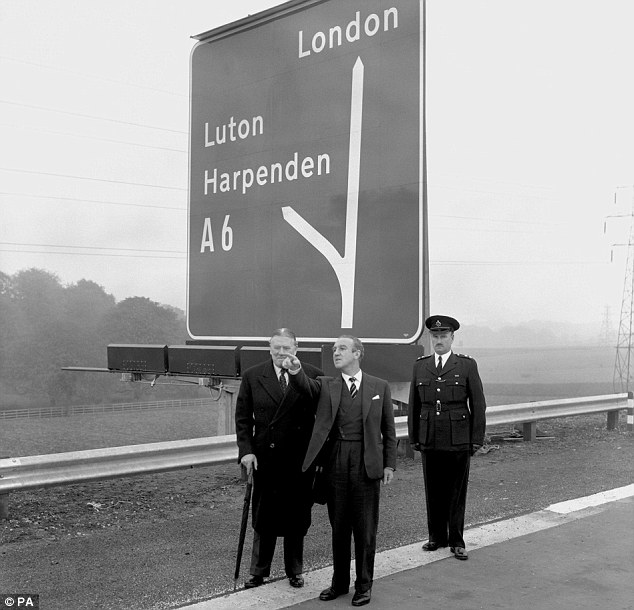
Britain's first motorway, the Preston Bypass, was opened on December 5th 1958 by the then Prime Minister, Harold Macmillan; four hours after the opening ceremony, Harold Bradshaw earned a place in UK motoring history when he became the first recorded motorway casualty after falling from a bridge above the road.
Hot on the heels of the Preston Bypass came the M1, the first section, just over 61 miles long was opened in 1959 - this was the start of the 'backbone' that would bridge the great North/South divide; unintentionally, it also provided a test track for high-performance sports cars!
There are few things that you need to know before setting off on a motorway journey. The first is whether or not you are actually allowed on the motorway.
Not allowed:
If you plan a Sunday afternoon walk, or a horse ride on the motorway, I'm afraid you're out of luck... Nor will you be able to ride your motor scooter (or bike) if it engine is less than 50 cc, or go for a spree on your tractor!
Learner motorcyclists are prohibited from motorways but from June 4th 2018 learner drivers in cars will be allowed on motorways if accompanied by a fully qualified driving instructor in a dual-controlled car.
You and your car:
It's common-sense to have a vehicle that is fit for the road; however, this becomes even more important when you are contemplating a motorway journey. Driving at higher speeds over long distances is sure to test the weakest components of your vehicle. You can guarantee that if your car is about to break down it will do so miles from anywhere on a windy wet stretch of motorway - at night!
In the same way that your car needs to be in good condition, you also need to be fit and alert. The higher speeds on motorways mean that things can happen very quickly – a moment's lapse of concentration could have dire consequences.
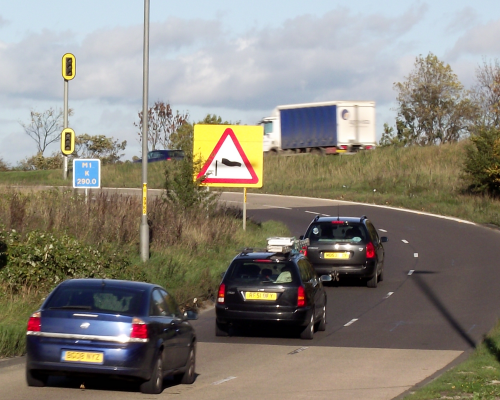 On most occasions you will join the motorway via a slip-road and an acceleration lane, at other times you might join from a roundabout or simply from the extension of the dual carriageway.
When joining the motorway via a slip road, it's important to remember that you are the 'odd one out' – the one who has to fit in with the flow.
Build up your speed on the slip road so that it matches the traffic on the motorway. Doing this is important, otherwise you will become a hazard to both yourself and other drivers.
As you're building up your speed on the slip road, check your mirrors and signal 'right' to show that you intend to join the motorway.
A lot of people will argue that it shouldn't be necessary to signal - after all where else are you going to go when you are heading down a one-way road at 60mph?
But... Your signal is important and fulfils the following functions …
You now need to start looking for the gap in the traffic.
A useful tip here is to decide which vehicle you want to follow rather than which vehicle you intend to drive in front of. This will help to keep your attention on the road ahead and will help you to maintain a positive speed.
As you approach the main carriageway you will enter an 'acceleration lane'. This lane is provided for you to make final adjustments to your speed as you prepared to merge with the traffic in lane-one (the lane that runs next to the hard shoulder).
 Make sure that you check all of your mirrors - a quick glance in the left mirror to look for idiots overtaking on the left; a glance in the centre mirror to find out who is following and a couple of glances in the right door mirror to check that your gap is still available.
At this point you might want to have a quick glance over your right shoulder to double check that all is well.
Look back?
Some experts disagree with the idea of a final shoulder check saying that it can distract you from the road ahead. If you're travelling at about 70mph and your glance takes around half a second, you will be distracted from the road ahead for a distance of about 20 metres … However given that you should be leaving the gap of at least 70 metres between your vehicle and the vehicle in front, the should not be a problem. Take my advice … Have a quick glance back!
If you don't drive regularly on motorways, or have been driving in a slow urban environment for the last half-an-hour or so, it's a good idea to stay in lane-one for a while to get used to the higher traffic speeds.
In the same way as on dual-carriageways, the higher speeds on motorways can cause things to happen very quickly. In order to cope with varying traffic conditions or emergencies you must stay alert and look well ahead (at times you might spot brake lights as far as a mile or more ahead!).
 Not like I did!
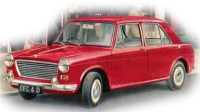
My first (far from high-performance) motorway experience was in a borrowed Morris 1100. Approaching the main carriageway I realised that the convoy of military vehicles in lane-one had no intention of moving over. The result was that I panicked and stopped in the acceleration lane… I was parked for over ten minutes until the fear of sitting there overcame my fear of moving!
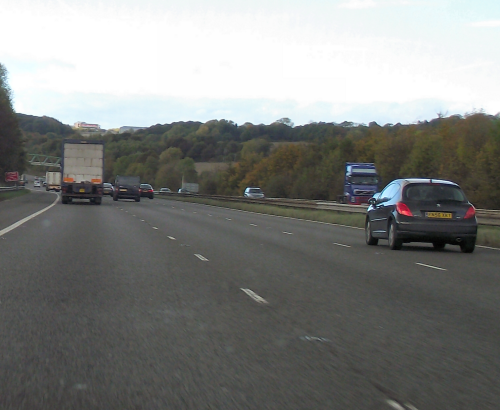 The normal rule is to use the left-hand lane unless you are overtaking, but keep a look out for road signs and markings; sometimes (especially in places where motorways merge) the left-hand lane might lead away from your intended destination.
Allow plenty of time for your actions on the motorway. Consider every move carefully making the fullest use of your mirrors and giving other drivers plenty of time to see your signals before starting any manoeuvre.
'Allow plenty of time for your actions' means managing the speed and space around your vehicle. One of the best ways to do this is to use the 'two second rule'. You can find out about the 'two second rule' and other ways to manage space by clicking here.
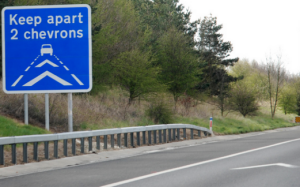
Some motorways have road markings to help you determine a safe following distance. Sometimes, two chevrons distance seems very long - but whether you believe it or not, that's the kind of distance you need to stop in a sudden emergency.
As mentioned above, the basic rule for lane use is 'drive in the left-hand lane unless you are overtaking'. It's amazing that such as simple rule seems to be misunderstood by so many drivers! Can it be so difficult?
They could be various reasons for people not sticking to the rules:
Whatever the reasons others have for driving dangerously, it makes good sense to adopt good lane discipline. By sticking to the rules you will help the traffic flow and reduced accident risks by lowering frustration levels.
Just because you think 70mph is fast enough for anyone, it doesn't mean that the driver of the sports car behind will think the same thing… just let him go - at least that way you won't be involved in his accident!
 Another reason for good lane discipline is to help truck drivers. When you are sitting in the middle lane at 45mph going up a slight incline it's hardly surprising that the truck driver behind gets frustrated.
Trucks take much longer to build up their speed and need to maintain the momentum to climb even the slightest inclines; they're not allowed to use the right-hand lane (lane-three) and so cannot overtake you. Added to this, they're probably working to some impossible deadline!
Bus drivers and vehicle towing trailers (that includes your boat trailer or camping trailer!) are also prohibited from using lane-three. Be aware however, that there are some very large vans that fall just under the weight limit. These vans are permitted to use lane three and could pull out in front of you unexpectedly'.
 Overtaking is easily and fairly straightforward on the motorway, simply allow yourself lots of space and time.
Start your overtake manoeuvre early and well back from the vehicle you wish to pass. the nearer you get, the harder it will be to pull out. This is because you won't have the space in which to build up your speed.
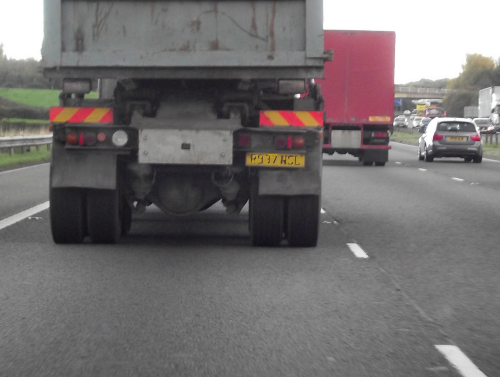
If you follow this closely you will have no chance of a safe overtake and the driver of the truck won't be able to see you in his mirrors ...
If the view in the picture is your normal view before overtaking you are at least 50 metres too close!
Give your signal early and allow it to flash a few times before starting to move - this will warn drivers behind of your intentions (as opposed to the normal method adopted by many drivers of putting on the signal after they have started the manoeuvre!).
Check your mirrors and a quick glance in your blind-spot (over your right shoulder) before moving out.
After you have overtaken, and as soon as you can see the overtaken vehicle in your centre mirror, move back to your original lane. Depending upon your position a signal might be useful.
Cancel your signal! Make sure that your signal is cancelled after use because there won't be enough steering action to self-cancel the signal during normal lane change manoeuvres on motorways. The signal check needs to be a positive act - because of road noise, or your favourite motorway driving CD you might not hear the indicators warning clicks - its also possible that you won't be checking your speedo quite as much and so won't notice the flashing light on the dash.
My basic rule for motorway signals is: 'If in doubt and give a signal'. If you are monitoring the traffic and leaving plenty of space a signal should not be needed as there will be plenty of time for others to see what you are doing - but as with joining the motorway there might be others that needs a 'wake up call' or those who are stupid enough to accelerate if they see a driver start to move without a signal - "You're not pushing in front of me without signalling!"
 Keep space to the sides
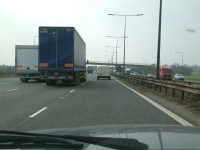
For extra safety when overtaking never put yourself into a position where there is no 'escape route'. For example if you are in lane three overtaking a lorry in lane-two, avoid getting stuck alongside it - make sure that there is plenty of room to pass on get ahead of it before starting to overtake.
In the example on the right, you would have to wait for the white van to move out of the way so that you have a clear space to drive into before you start to pass the truck.
You will normally leave the motorway via an exit slip road. If you are planned your journey well your first task will be to look out for the exit number.
All motorway junctions are numbered and the exit number can be found in the bottom left-hand corner of the direction signs in a black square with white numbers. The first direction signs for your junction will have the road numbers and the junction number - but will not 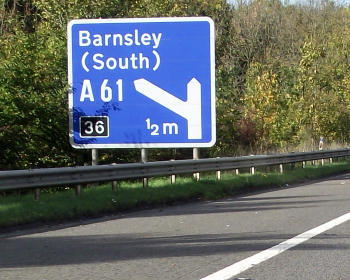 have names of the destination. This sign is one mile from the exit.
The second direction sign will be like the first but this time would include place names like the one shown on the right. This sign is positioned half a mile from the junction. By the time you reach this sign you should be thinking of moving back to the left-hand lane if you are not already there. Information is also given on gantry signs at some junctions.
Finally, you will see the countdown markers. These are placed 270, 180 and 90 metres respectively from the start of the deceleration lane.
As you pass the first countdown marker signal your intention to leave the motorway but maintain your speed - you can slow down in the deceleration lane and on the slip road.
Deceptive speed
As soon as you enter the slip road, check your speedometer; you might be travelling much faster than you think (50mph can feel like 30mph after a long fast journey).
Some slip roads have sharp curves that can take drivers by surprise if they are travelling to fast – beware!
If you break down, move to the hard-shoulder and switch on your hazard warning lights.
If you can't get to the hard shoulder because your car is damaged or stops and won't restart, switch on your hazard warning lights and get well clear to stand in a safe position. If your battery is good it can also help to leave sidelights on - especially in poor weather conditions.
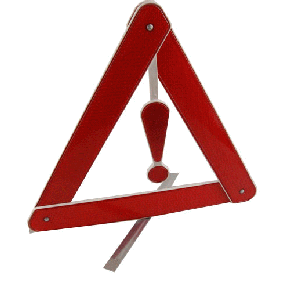
If you carry a red warning LEAVE IT IN THE BOOT. Although reflective triangles can be particularly effective at night, especially on narrow roads or fast A-roads they can cause problems on motorways.
The old safety advice was to place your triangle 150 metres behind your vehicle; however, it is now considered that the risks of walking to place and retrieve the triangle outweigh the benefits.
Other dangers are that the triangle can be blown into the road with the turbulence cause by large fast vehicles or knocked into the path of moving traffic causing further danger or accidents.
Try to warn other drivers if possible (by waving etc.) but do not stand on the main carriageway or try to stop drivers by running in front of them.
Use the nearside door to get out of your vehicle. If you have passengers with you get them out of the vehicle to place of safety such as the grass verge behind the hard shoulder. Wear hi-viz vests for added safety.
If you have any animals or pets with you leave them in the vehicle or ensure that they are securely held on a leash or appropriate restraint.
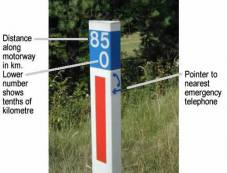 Inform the emergency services as soon as possible that you have broken down. Marker posts on the side of the road will direct to the nearest phone (never cross to a telephone on the opposite carriageway!). All the phones are numbered and connect directly to the police control centre. If you use your mobile phone to contact the authorities the marker posts at the side of the hard shoulder will be numbered - this will help the authorities to locate you.
It is not generally a good idea to try and repair your vehicle yourself on the hard shoulder. The high speed of traffic rushing by makes this a very dangerous environment.
Even if you only need to change a wheel wait until there is a a police or Highways Agency vehicle parked behind you to shield you from the traffic and to draw attention to your presence.
While you're waiting for the emergency services to arrive sit on the grass verge, well away from the traffic whenever possible - statistics about collisions on the hard-shoulder suggest that you will be safer there than sitting in your car. If you are disabled and unable to safely get out of your vehicle or have no mobile phone with you, switch on your hazard warning lights, display a 'HELP' pennant and wait for help to arrive.
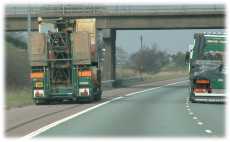 If you see other vehicles broken down on the hard shoulder, give them a wide berth. The truck driver in the photo on the right moved out, probably because he was aware that the driver of the broken down truck could walk around the front, or that the truck could start moving.
Finally, when rejoining the main carriageway after a breakdown or emergency, build up your speed on the hard shoulder (in the same way that you would joining the motorway from an acceleration lane) and then merge with the traffic in lane-one.
Download a Survive leaflet here with info about motorway breakdowns.
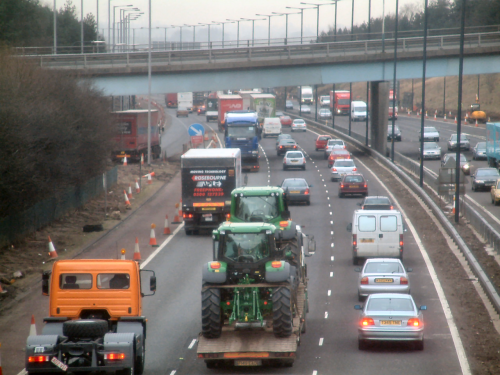 Britain's first motorway, the Preston Bypass, was opened on December 5th 1958 by the then Prime Minister, Harold Macmillan; four hours after the opening ceremony, Harold Bradshaw earned a place in UK motoring history when he became the first recorded motorway casualty after falling from a bridge above the road.
Hot on the heels of the Preston Bypass came the M1, the first 72 miles of which were opened on April 11th 1960 bridging the great North/South divide and providing a test track for high-performance sports cars!
Despite the fact that the motorway network is now several thousand miles longer than it was when I had my first motorway adventure back in the early 1970's, there is still no requirement for compulsory motorway tuition or testing. Anyone who has passed the practical driving test can jump into a car and dive headlong into an experience similar to my own!
What has changed, however, is that although learner drivers are not permitted on motorways, the Theory-Test (compulsory for all new drivers) requires candidates to answer questions about motorway driving. This leads me to wonder how many learner drivers know more about motorway rules and regulations than the full licence holders who have been driving on motorways for years!
Whether or not motorway training becomes a compulsory requirement, there might well come a time when it will no longer be an issue. One idea that has been researched, and for which the technology already exists, is that of linking cars together on motorways. Using on-board computers coupled with speed/distance sensors, it is possible to form a motorway train. After 'logging on' to the train, you could read a newspaper, fall asleep or simply sit back and enjoy the ride. For now though, sleeping safely on the motorway remains a distant dream.
Although statistics suggest that motorways are our safest roads, they do pose significant risks, especially for those who don't regularly drive at higher speeds. Statistics also tell us that driver error is present in 90% of motorway accidents (with mechanical failure accounting for only 10%). So how safe are you now and what can you do to maximise your future safety on the motorway?
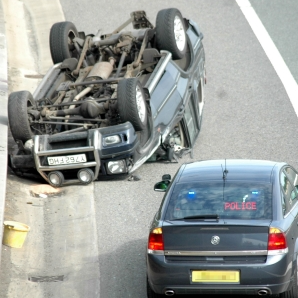 Most motorway accidents are caused by one, or a combination of the following:
Over the years, many individuals and organisations (Including the Institute of Advanced motorists and some Chief Police Constables) have called for increases in motorway speed limits; however, others think that this would be a recipe for more accidents. Although higher speeds will inevitably increase the severity of accidents, speed in itself is not usually the cause of motorway accidents.
Whatever your views on speed limits, driving more slowly will not necessarily reduce your risk of an accident on the motorway. The real problem lies in the way that drivers use speed on motorways. Consider the following figures:
Given the information above, it doesn't take a mathematical genius to work out that drivers who only leave a separation gap of three or four car lengths when travelling at 70 mph will not have a chance of stopping if faced with a sudden emergency.
By keeping a one-metre gap for each mile per hour of your speed, or applying the 'two-second rule' you will do a lot to reduce your risk. Another major benefit of maintaining a safe distance is that it will give you plenty of time and space for safe, well planned lane changes – it's estimated that up to 25% of motorway accidents are caused by reckless or late lane change manoeuvres.
The problem with vehicle separation becomes even worse in poor weather conditions. On a wet road your stopping distance will often double, but that's only part of the problem. In order to achieve this stopping distance, your wheels need to be in contact with the road surface.
Because of the width of motorway carriageways it is not possible to achieve the same degree of camber that is found on narrower roads; this means that in a heavy rainstorm, water will not drain as quickly and there is a possibility of standing water – this can cause your front wheels to lose their grip on the road surface (aquaplaning). Stay safe in the wet by reducing your speed, doubling your separation distance and turning off cruise control.
One of the biggest motorway killers is fog, or rather the way that some drivers behave in foggy conditions. It never ceases to amaze me that despite at least one major fog smash making the headlines every year, drivers still hurtle along foggy motorways as if it were a bright summers day! My best advice about driving in motorway fog is "Don't".
Click these links to find out more about Fog and Winter Driving
As cars become more sophisticated, the potential for driver distraction is perhaps greater than ever before. Mobile phones, global positioning systems, route finders, sophisticated in-car entertainment, etc., all require the driver's attention; however, tiredness remains one of the most dangerous blocks to motorway concentration.
 Many of our motorways now have signs reminding us that: 'Tiredness kills – Take a break'. The causes of sleepiness vary from driver to driver but no one is immune. It could be the heavy meal and couple of drinks you had earlier, or medication from a doctor or pharmacy (many over-the-counter medicines cause drowsiness). Long straight stretches of motorway result in some drivers succumbing to the hypnotic effect of the white lines flashing by, especially if they are bored or tired.
If you feel drowsy, pull off the motorway at the next exit or service area for a break. A caffeinated drink and a twenty-minute catnap will help to keep you to recover.
Beware!
If you do pull in for a break don't make the same mistake as the German tourist who was stopped by the Wiltshire Police after driving for 30 miles without realising that he had left his wife behind at the service station. (Nice try!)
Sometimes, because of breakdowns or other emergencies, drivers are forced to park on the motorway. It's very important to keep your wits about you in this situation and (unlike the man who was found trying to change a wheel in the outside lane of the M1) get off the main carriageway to a place of safety – namely, the hard shoulder. This is one of the first rules taught in driving instructor training about motorway lessons.
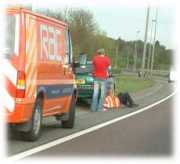 Although I refer to the hard shoulder as a place of safety, it is actually one of the riskiest places on the motorway. If you are forced to stop on the hard shoulder, switch on your hazard lights, inform the authorities immediately and stay well clear of your vehicle while waiting for help.
Even if you can fix the problem yourself, for example changing a wheel, you will be a lot safer if there is a conspicuous police or breakdown patrol vehicle providing a protective shield behind your car.
So ... Remember the basic survival rules for driving on the motorway: